


DRESS CODE
THE WESTERN RENAISSANCE IS HERE. What began as a whisper with Raf Simons sending Kaia Gerber down the Autumn Winter 2017 Calvin Klein runway in a silk color-blocked western shirt and cowboy boots has swelled to a choir in 2024. The modern-day western tv phenomena that is Yellowstone. Post Malone’s pre-pandemic Nudie Suit phase. Scorsese’s period western Killers of the Flower Moon. Pharrell Williams’ wild, wild west Louis Vuitton AW24 show, his inaugural collection for the Parisian house, was wildly over the top western. Bella Hadid is dating a professional cowboy (and was even TikTok’d in the Target parking lot in my hometown of Weatherford, Texas). Even Beyoncé’s gone country.

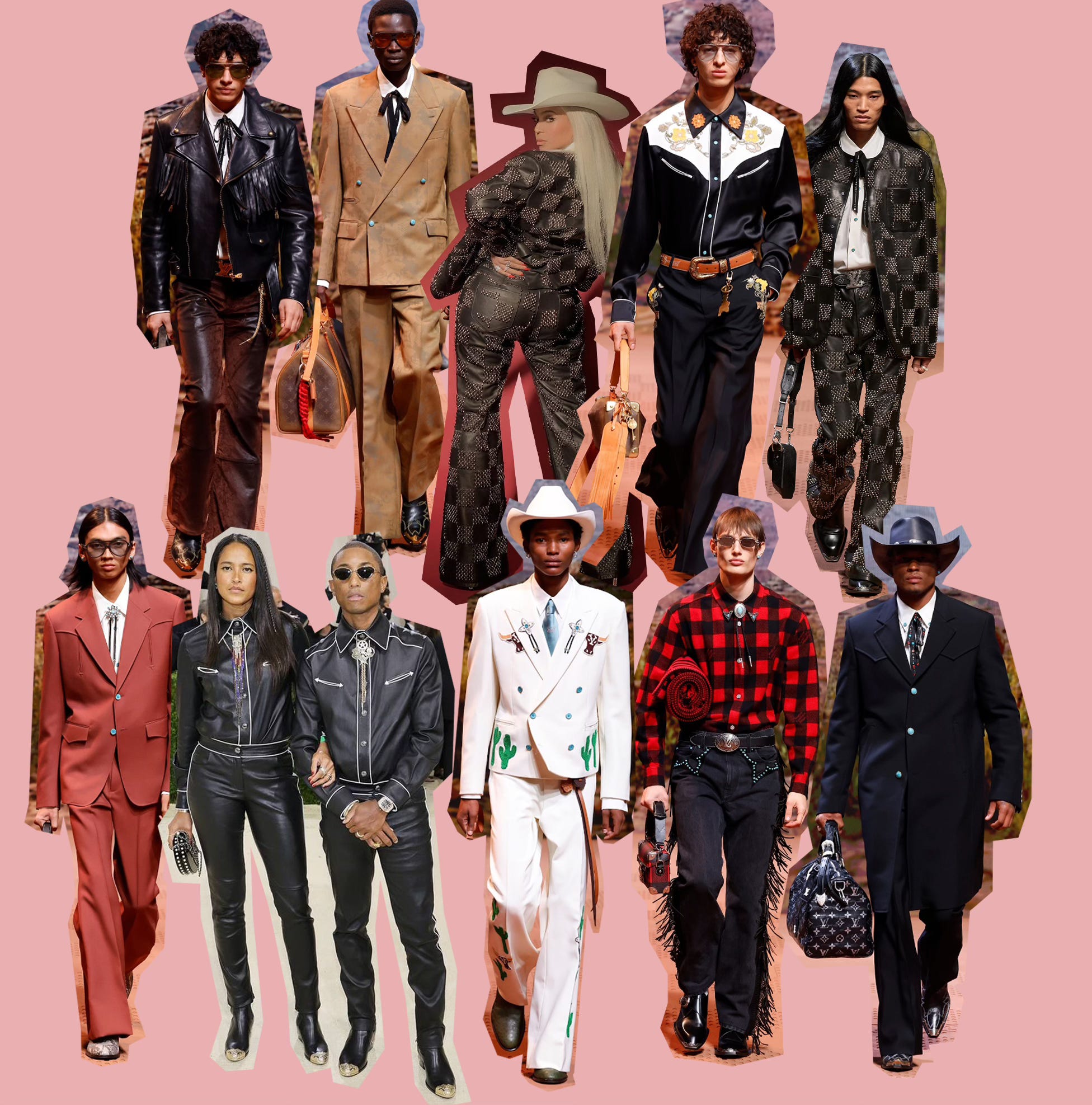
So how to get up on the horse per se…the boots, the hat, the bolo tie, the western shirt, the bootcut jeans, the western belt, the fringe…not all at once, obviously, unless you’re auditioning as an extra on Yellowstone. Keep the western pieces to two, at most three, in most rigs. As a native Texan, I eagerly embraced the domino Simons tipped over at Calvin Klein seven years ago.
There are certain patterns and cloth in menswear that inherently possess a western bent. Rob Roy tartan—also known as buffalo plaid—as seen in the Vuitton show above and the F.E. Castleberry dinner jacket I designed below. Dogstooth, guncheck, tweed, and of course solid navy round out the bunch.

But think more Andy Warhol than Louis Vuitton (albeit done extremely well at the high fashion level). Warhol’s best uniform consisted of a navy blazer, repp stripe tie, Brooks Brothers white oxford, jeans, and cowboy boots. Sometimes he’d swap the white shirt out for a sportier tartan plaid oxford. Forty five years later, it still works. I think the Versace tie ASAP Rocky pairs is incredibly chic. Below, I’m wearing a vintage Gucci equestrian motif tie with black boots…but opted for the double breasted grey dogstooth jacket.

BOOTS: I love a black snip toe boot. They pair easily with tailoring and the toe shape feels more fashion than farmhand. Consider Lucchese or Wythe (I love mine). Try eBay at your own peril if you’re contemplating vintage.
COWBOY HAT: It doesn’t get better than the Stetson Open Road if you’re wearing a hat in the city. Iconic silhouette with the cattleman’s crease, not too big. The silverbelly color (which I wear) keeps you from looking like a sheriff or park ranger.
BOLO TIE: I’ve designed a couple bolo ties with Master Jeweler Isaac Dial, who is of Navajo and Lumbee descent. They’re really special. Direct message him on Instagram for a custom piece or scour eBay or Etsy for vintage ones made of sterling silver, preferably with turquoise stones.
WESTERN BELT: One of my most prized accessories, my honey brown western alligator belt with sterling silver hardware I sniped for a song on eBay. I’m still hunting for a black one. The western belt on its own in a dark suit and tie ensemble is chic enough to carry the entire operation.
JEANS: I wear RRL jeans (straight fit), Ralph Lauren’s western label, in large part because of the wide array of fits, they’re made in the USA from Japanese denim, and I used to design there. The Wrangler Cowboy Cut is a solid economical option for those on a budget.
CRATE DIGGING
Crate Digging is about discovering old music. The classics. The obscure. The looked over. The uncut gem. The minor masterworks. It’s a liberal arts audit of the music that scores the world of F.E. Castleberry. Alternative. Punk. Post Punk. Classical. Rock. Pop. Afrobeat. Grunge. Blues. But let’s start with jazz, shall we?
LEGEND HAS IT that when drummer Rashied Ali walked into the Van Gelder Studio in Englewood Cliffs, New Jersey for his latest session with John Coltrane, he was confused as to where the rest of the saxophonist’s band was. The quartet that had laid down the masterpiece Love Supreme was nowhere to be found. Coltrane looked up and simply said, “It’s just going to be you and me.” The year was 1967.
Over text, my friend Alex Beh and I sustain a long rally of jazz albums from the 1950s and 60s. Our mutual love of this particular era of jazz is one of the great joys of our friendship. The more obscure, the more deft the shot. John Coltrane’s Interstellar Space was one such album I’d sent over the net to Beh…certain it wasn’t in his library yet.

If you aren’t familiar with 1958’s hard bop masterpiece Blue Train, 1960’s harmonic breakthrough Giant Steps, and 1965’s majestic modal prayer A Love Supreme, take those in first, buy the vinyl, get lost. Those recordings are cornerstones in the jazz canon. Interstellar Space is something different entirely…an unqualified free-jazz masterpiece veering so far out into the ether that HIS OWN SON, growing up, admits his “ears could only make it up to 1965,” alluding to the year when Coltrane’s so-called “classic quartet” of the early-to-mid-Sixties began to splinter. A critic once called the “Late Coltrane” era’s Interstellar Space “rousing if somewhat inaccessible music.”
Drummer Rashied Ali on the session:
“Everything was completely spontaneous except for at times I would ask [John] to give me some kind of clue as to what was happening,” the drummer said. “Like, ‘Is this going to be slow like a ballad?’ or ‘Is this going to be in a certain time, like 3/4 or 4/4?’ … Because, you know, he would just ring the bells, pick up his horn and start playing.”
What intergalactic dimension Coltrane and Ali entered that day in ‘67 sat in the ABC archives, the Impulse! label’s parent company, until 1974. The name Interstellar Space and album art were not chosen by Coltrane (as only the songs had been given planetary titles) and eschews the industry practice of the day of featuring the saxophonist in favor of a serene scene of the sun above clouds. Art work more befitting such a transcendent effort. What at first sounds chaotic—the gravitational colliding of notes, bangs, and bells—settles into what could only be described as the genius of a planet being born.
Sax.
Drums.
A minimalist deconstruction of all jazz as we knew it, joining the painter Cy Twombly in the abstraction of their respective mediums. Interstellar Space will sound like a foreign language, albeit a Latin based tongue in that the vocabulary will sound vaguely familiar (we’re acquainted with the sound of drums and a saxophone), but still foreign…until it’s not. This is Coltrane’s last (and formerly lost) masterpiece.
Sit cross legged.
Drop the needle.
Light the incense.
Receive the sermon.
BOOK CLUB
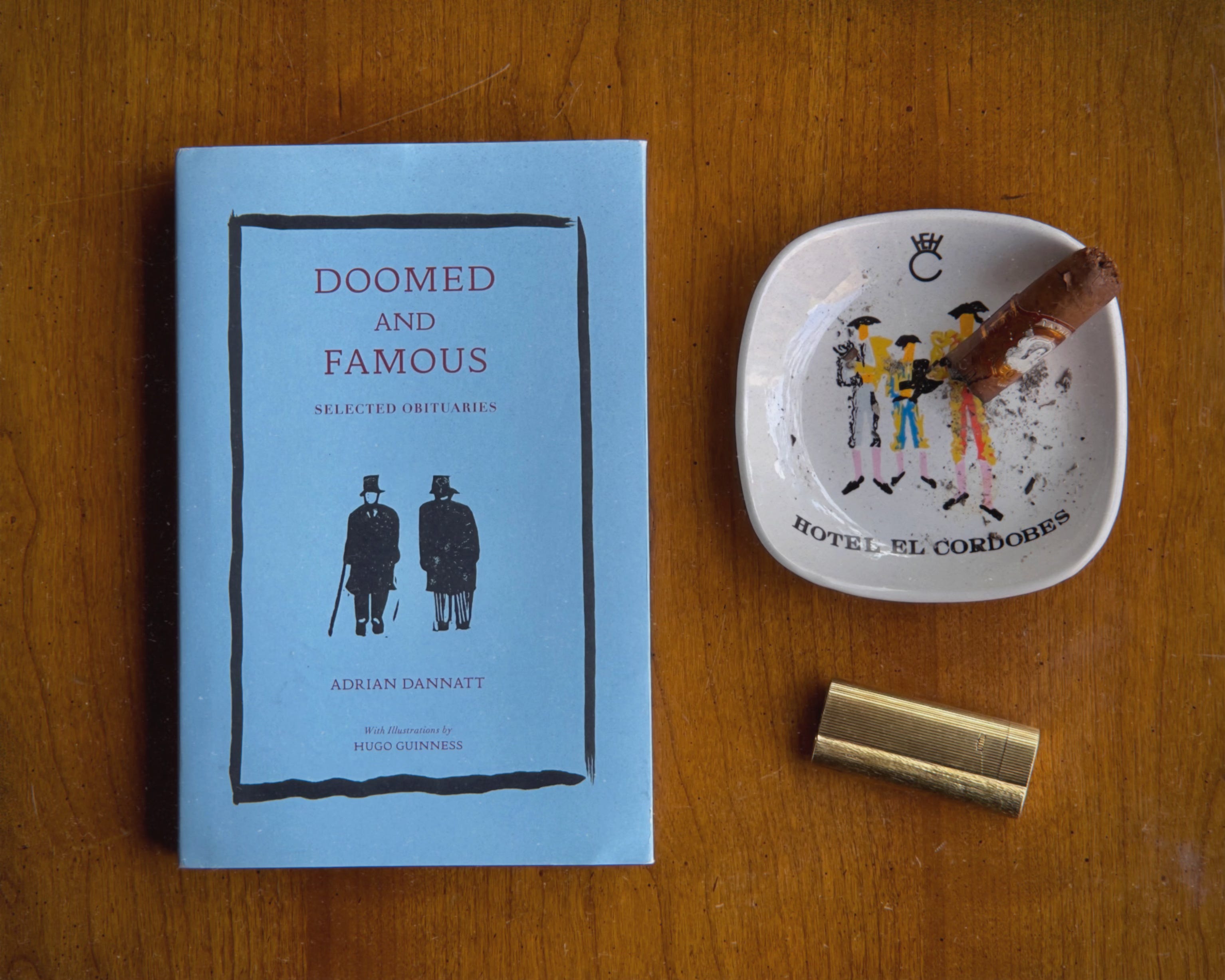
WHEN WAS THE LAST TIME you read an obituary? Toss that quarter in the fountain during your next date or dinner party. For the last two years, I’ve been reading Adrian Dannatt’s Doomed and Famous, a collection of improbable obituaries celebrating the obscure and the eccentric. That’s right, obituaries. I indulge in them as bedtime stories [I’ll unpack the intricacies of what that means in therapy at some point but I suspect it provides me some odd comfort in knowing that nobody has all their shit together at any given moment in life]. Dannatt’s specialty, much in demand among even the most mainstream publications, was to memorialize those whose eccentricity or criminality made them unlikely candidates for the fleeting immortality of a newspaper necrology.
His subjects have largely lingered in the creative arena, whether artists such as Dash Snow, Ray Johnson, and Dorothea Tanning or filmmakers such as Sandy Whitelaw and Gian Luigi Polidoro. He documented the premature demise of novelist Robert Bingham (a personal favorite) as well as a scattering of dangerous poets, including Rene Ricard, Gellu Naum, and Bernard Heidsieck while memorializing a leading downtown Manhattan dominatrix along with a conceptual artist who blew up a museum…to name a few.
What Dannatt achieves in the medium of the 1,000 word obituary is nothing short of inspired. Here, the obituarist's final words on the life of one Pierre André-May, a personal favorite from the selected obits presented in the book.
PIERRE ANDRÉ-MAY
THE large role of the little magazine in twentieth-century literature is exemplified by the French journal Intentions whose founder, editor and owner Pierre André-May recently died aged 98. Intentions only existed for three years, between 1922 and 1924, but in thirty issues published an extraordinary range of major talent whilst encouraging a whole generation of younger writers. This was all the more remarkable as André-May was then in his early 20s, had never before been involved in publishing, and created and sustained Intentions entirely by himself without even a secretary; soliciting, selecting, editing and printing everything that appeared in its pages.
Publishing was, however, in his blood. Born in Paris in 1901, André-May's maternal grandfather was editor of Le Moniteur de la mode and his father, a doctor, was director of the Journal de Médecine. André-May grew up between his parental apartment in the Rue de Phalsbourg, in the seventeenth arrondisment, and their petit Château de Blanchefort in Nièvre. At this chateau, André-May, a single child reading in rural seclusion, developed his obsession with literature and theatre. As he later wrote, “I spent the time of my adolescence in too large a solitude.” After Lycée Carnot he began law studies to please his father, and having done well in exams the latter offered him the chance to start his own publication as a reward. His father put his own printer at André-May's disposal, and gave him financial backing for the entire undertaking. He was already an habitué of the famous bookshop Maison des Amis des Livres run by Adrienne Sonnier in the Rue de l'Odéon. Monnier and her shop were central to André-May's enterprise, and it was thanks to her recommendation that he secured contributions from many major writers.
In December 1921 André-May published a press release for his new journal in several newspapers, and as promised the first issue of Intentions was distributed on January 2, 1922. With its elegant gray covers and deep black typeface, Intentions was noted for its design as well as its editorial statement. Acknowledging that many new literary journals rubbish their predecessors and claim most contemporary writers without value, by contrast André-May wanted to reestablish the cult of veneration and pay humble homage to many living masters. This was an intelligent position in keeping with the journal's taste for Classicisme moderne rather than radical avant-gardism, and though only a modest thirty-two pages, selling for two francs, the first issue garnered attention and praise. André-May ran the entire business from his parents' apartment, where he was "at home" every Saturday between four and six to receive potential collaborators. He continued to live at Rue Phalsbourg for much of his life.
Marcel Proust was one master, who André-May visited on his deathbed, after having published two rare texts at a time when it was still a risky choice. Indeed, one reviewer called the extract, “a heavy slice of the new 'pudding-psychologique of Monsieur Proust.” Paul Claudel, who never published his work in journals, sent Intentions a suite of twelve poems from Tokyo where he was then ambassador. André-May also managed to persuade another writer-diplomat, Saint-John Perse, to contribute, as well as Jules Supervielle, who divided his time between Paris and Montevideo. André-May's persuasive powers resulted in a long roll call of distinguished contributors: poems by Pierre Reverdy and the very young Michel Leiris, texts by Philippe Soupault and André Breton, works by François Mauriac and Raymond Radiguet, and topical reviews by everyone from Paul Eluard to Robert Desnos.
The format of Intentions was to introduce a writer's work followed by a critical essay on the author, and thus some figures appeared both as contributors and critics. Max Jacob, for example, wrote an essay on the notorious Marcel Jouhandeau (whose novel Monsieur Godeau was published in long sections in five consecutive issues, to as much protest as praise, and was even sent by Gide to Arnold Bennett) as well as his own poetry. At the nightelub Le Boeuf sur le Toit, André-May met the composer Darius Milhaud, whom he persuaded to write essays on contemporary music including an early appreciation of American jazz. Intentions also published special issues, the first of which was dedicated to Valery Larbaud, for whom André-May also hosted a celebratory dinner after his Légion d'honneur: Larbaud, still enjoyed today in France, is perhaps best remembered elsewhere for his championship of Joyce, on whom a special number was planned for January 1924. In the end this did not appear, nor did an issue on Gide, but Joyce's short story, “The Sisters,” was published in translation in 1922. Larbaud was also behind a special Spanish issue which introduced the “Ultraïste” movement to France, and such writers as García Lorca and Ramón Gómez de la Serna.
Distribution was always a problem, as it remains for any small literary journal, and though Intentions was placed in bookshops from Japan to Chile by its contributors, no issue probably sold more than three hundred copies. Thus despite strong letters of appreciation and support from Max Jacob, Proust, Gide and Cocteau, Intentions was forced to close when André-May's father decided he could no longer cover costs. The last issue, a triple number (28-30), came out in December 1924 and still owing money to the printer, André-May was forced to sell some of his rare books via Monnier. André-May was then only 23, and after working in his father's office he began dealing antiques, later opening a shop on Rue de St. Père where he bought and sold beautiful objects for the rest of his life.
This impeccably discrete retirement from literary life was only interrupted by the publication of his novel Le Matin in May 1945, a bad year to issue a book, not least because as an aesthete André-May must have been horrified by the cheap paper Éditions du Pavois were obliged to use, which by now is as brown and brittle as toast. Le Matin is not without its charms, a very French coming-of-age romance heavily indebted to Proust. André-May kills off his father as a doctor at the Front and details his adoration for his mother, stealing into her bedroom to watch her sleep and falling asleep himself with her letter pressed to his heart. The atmosphere of adolescence at a small chateau is charmingly caught, creating his own marionette theatre complete with candles, spying on a beautiful local servant boy with blonde curls in the enchanted domain of the jardin d'hiver.
Despite relative poverty, André-May always lived in a beautiful apartment, which cost almost nothing having been rented from before the war, surrounded by exceptional pieces saved from his shop and portraits of his many adored dogs. His only luxury was a full-time butler, a difficult man only a few decades younger than himself, who would often forbid guests due to his reluctance to cook. This life of elegant obscurity was mitigated through his rediscovery by the young literary scholar Béatrice Mousli, who dedicated her thesis to André-May, the oral defence of which the great man himself attended with his even more elderly female coterie. Mousli published a fascinating book, Intentions, histoire d'une revue littéraire des années vingt (Ent'revues, 1995), without which no appreciation of André-May- including this obituary-would be possible. Thanks to Mousli, André-May's place in literary history has been replotted, as the French diplomat and critic Henri Hoppenot foresaw: "It is something for you to be able to say that one could never now write the history of three major years in French literature without citing Intentions.”
Pierre André-May, literary editor and antique dealer; born Paris, January 15, 1901, died Paris, April 1, 1999.
Pick up a copy of Doomed and Famous for your own nightstand.